
Last Updated: September 14, 2026
TL;DR
Market intelligence is the systematic collection and analysis of external data — competitor pricing, promotions, assortment, and availability — across retailers and marketplaces.
It goes beyond pricing alone. Where price intelligence answers “How are we priced?”, market intelligence answers “What is happening across the entire market?”
Retailers and brands use it to monitor competitive behavior, identify gaps, and make faster, better-grounded decisions on pricing, assortment, and strategy.
What is market intelligence in retail?
Short answer: The use of external market data to understand competitor behavior, pricing, and product performance across retailers and channels.
Market intelligence refers to the ongoing collection and analysis of external market data. It captures how competitors price, promote, and position products across multiple retailers, giving teams a structured view of the broader competitive landscape.
Unlike internal analytics, which measure your own performance, market intelligence measures what is happening around you. It is the foundation for competitive intelligence in retail
What data does market intelligence include?
Short answer: Pricing, promotions, assortment, availability, and ratings/reviews, collected continuously across multiple retailers and marketplaces.
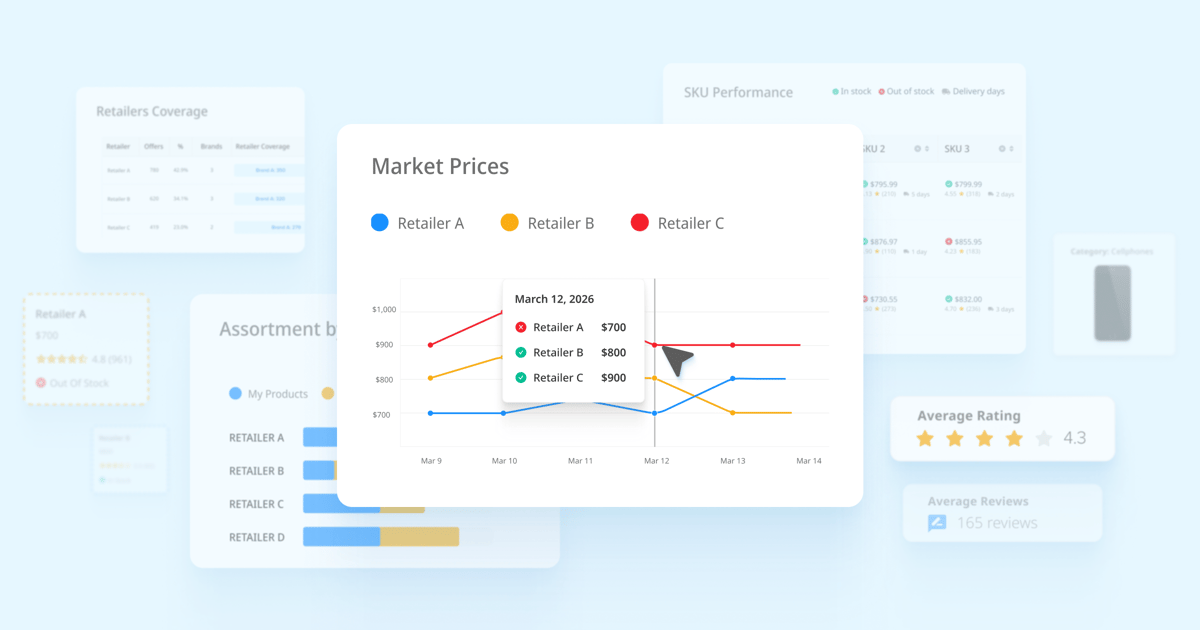
Market intelligence brings together several distinct data types, each answering a different question about the competitive environment.
Core data types
| Data Type | What It Includes | Why It Matters |
| Price | Competitor prices, discounts, price history | Understand price positioning and track changes over time |
| Promotions | Sales events, bundles, discount depth and timing | Track promotional strategies and timing |
| Assortment | Products carried by each retailer | Identify gaps and overlaps in product offerings and category coverage |
| Availability | In-stock / out-of-stock status by SKU | Detect demand signals and lost sales opportunities |
| Ratings & Reviews | Star ratings, review volume, sentiment trends | Evaluate how shoppers respond to your own and your competitors' products |
These data types are collected across retailers and marketplaces and refreshed on a recurring basis, enabling continuous visibility into how the market is shifting.
How do retailers and brands use market intelligence?
Short answer: To turn external market data into competitive intelligence that drives faster, more confident decisions across pricing, assortment, and commercial strategy.
Market intelligence supports decision-making across pricing, ecommerce, category management, and trade marketing teams by replacing assumptions with evidence about what competitor behavior and market trends.
Common use cases
-
Understand competitive positioning: Compare how your products are priced, promoted, and positioned relative to category rivals.
-
Track market changes: Monitor pricing, promotions, and assortment shifts as they happen, not after the fact.
-
Identify assortment gaps: See where products are missing, overrepresented, or underperforming in a category.
-
Analyze promotional activity: Understand competitor promotion timing, depth, and frequency to inform your own calendar.
-
Monitor product availability: Flag out-of-stock patterns that signal demand shifts or competitor vulnerability.
Curious how others use Market Intelligence? Delve into our Very and Brandt case studies.
Why is market intelligence important in retail?
Short answer: Because retail markets, especially in ecommerce, move fast. Teams that lack structured market data are making decisions on incomplete information.
Pricing, promotions, and assortment can shift multiple times per week in competitive ecommerce categories. Without a systematic feed of market data, teams are typically working from snapshots that are days or weeks out of date.
Market intelligence provides a consistent view of the market so teams can:
-
Monitor competitor behavior across retailers through structured competitive intelligence
-
Respond to pricing and promotional changes before they affect share
-
Align pricing, merchandising, and ecommerce strategies around what the market is actually doing
When do organizations need market intelligence?
Short answer: When pricing data alone is no longer enough to explain performance and when competitive context is missing from critical decisions.
Most organizations start with pricing data. Market intelligence becomes necessary when:
-
Prices are changing frequently across multiple competitors and channels
-
Promotional activity is influencing category dynamics as much as base pricing
-
Out-of-stock events are affecting demand, revenue, or category share
-
Teams need a full-category view, not just SKU-level comparisons
At that point, layering in assortment, availability, and promotional intelligence alongside pricing data is what enables confident, fast decision-making.
Final takeaway
Market intelligence gives retailers and brands a structured view of how products, competitors, and categories behave across the market — continuously, not just on request.
It brings together pricing, promotions, assortment, and availability data to produce actionable competitive intelligence that goes beyond what price monitoring alone can provide.
For teams operating in fast-moving ecommerce environments, it is the foundation for informed decisions on pricing, assortment, and commercial strategy.