
.png?width=1200&name=BLOG-Why%20100%25%20Data%20Accuracy%20Is%20a%20Myth%20(and%20What%20to%20Ask%20Your%20Vendor%20Instead).png)
Last Updated: September 14, 2026
Ask any competitive pricing vendor how accurate their data is and you'll get a confident number back. The trouble starts when a category manager pulls up a report, spots a price that's clearly wrong and realizes the accuracy on the pitch deck and the accuracy they're receiving aren't the same thing.
That gap is critical. A pricing decision built on a handful of bad matches doesn't just produce one wrong number. It produces a wrong call on margin, a MAP violation that gets missed or a repricing rule that fires on the wrong product entirely. And once a team stops trusting the data, they start double-checking everything by hand, which defeats the point of buying the data in the first place.
The real question is what is "accuracy" measuring?
Two vendors can both claim 98% accuracy and mean different things by it.
-
Accuracy answers one question: of the matches we found, how many are genuinely the same product?
-
Completeness answers a different one: of all the matches that should exist, how many did we actually find?
-
Match rate answers a third: of the products in your catalog, how many have at least one competitive match at all?
A vendor can hit 98% accuracy but still miss half of the matches out there, or they can get 100% match rate, but most of those matches are wrong.
Sample size matters just as much. Taking a small handful of SKUs for a human to manually review isn't giving you a reliable number. Data quality should be measured at a scale appropriate to your own with a sample size large enough to produce a confident, significant result. r gets less reliable exactly as your business gets bigger and the stakes get higher.
What to ask your vendor instead
The number itself is less useful than the answer to how they got it. A few questions worth asking before signing anything:
-
Do you report accuracy, completeness and match rate as separate numbers, or is one figure blending them together?
-
How do you measure accuracy and completeness and at what confidence levels?
-
Can you show accuracy and completeness broken down by category or retailer, not just a single number?
-
What's the underlying matching approach and how do you decide when a match is uncertain rather than automatically confirmed?
-
How often do you measure data quality and is the sample randomized each time?
-
What happens when a match is wrong? (This does happen, so worth knowing what the process is!)
How Wiser does it
No vendor should claim 100%, including us, and we'd rather show the mechanics than post a bigger number. Wiser tracks accuracy, completeness and match rate as three separate figures, reported by category and/or by retailer rather than as one blended account-level average.
Matching runs through two methods in parallel: a token-based comparison and a vector-based comparison that plots product attributes in space and measures how close two listings actually are.
Matching runs on a combination of rules-based and AI-led comparison, with a human check on anything the models flag as uncertain rather than auto-approving it once a confidence threshold is cleared.
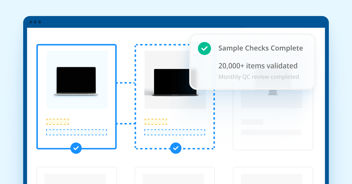
That process doesn't run once and stop. Samples are randomized rather than pulled from the same easy, already-confirmed SKUs each cycle, and checks run domain by domain, so it's built to catch the kind of gap that hides inside a healthy account-wide average and that a less granular process would miss.
Check out our Data Quality questionnaire to bring to all your conversations!
FAQs
No. Retail catalogs change too frequently, and matching products across retailers involves enough judgment calls that some error rate is unavoidable at scale. Any vendor claiming perfect accuracy either hasn't measured it rigorously or is defining "accurate" narrowly enough to hide the gaps.
Accuracy measures whether the matches a vendor found are genuinely correct. Completeness measures how many of the matches that should exist were actually found. Match rate measures how many products in a catalog have a competitive match at all, out of every product in the catalog. A vendor can report high accuracy while missing a large share of the market, since a narrow, cautious match set will always look more accurate than a broad one, and a high match rate on its own doesn't say whether those matches are right.
Ask whether they report accuracy and completeness as separate numbers, what sample size they use and whether it scales with catalog size, whether they can break results down by category or retailer, how often QA is re-run, and what human review process catches uncertain matches before they reach a report.
Sample size determines whether you're getting a statistically significant result at a high confidence level and a low margin of error, or just a number that happens to look good. A fixed sample size checked against a growing catalog represents a shrinking share of the data over time, so the read gets less reliable exactly as the catalog it's meant to represent gets bigger. Proper sampling scales with catalog size and retailer count, which is what gives you a reliable read on real-world performance rather than a guess dressed up as a metric.
Not on its own. A vendor chasing match rate can lower the confidence threshold for what counts as a match, which pulls more listings in but drops accuracy at the same time. A high match rate paired with a high accuracy number is the combination worth asking for, not either one alone.
Quarterly at minimum, and after any new catalog or new retailer is added to scope. A number quoted during the sales process reflects one moment in time and the questions in this post are worth re-asking on a schedule.
If a vendor can't break accuracy down by category or retailer, can't say what their sample size is or treats the question as unusual rather than routine, that's usually a sign the number they quoted hasn't been checked as carefully as it sounds or that they don’t measure it at all.