
Last Updated: January 15, 2026
TL;DR
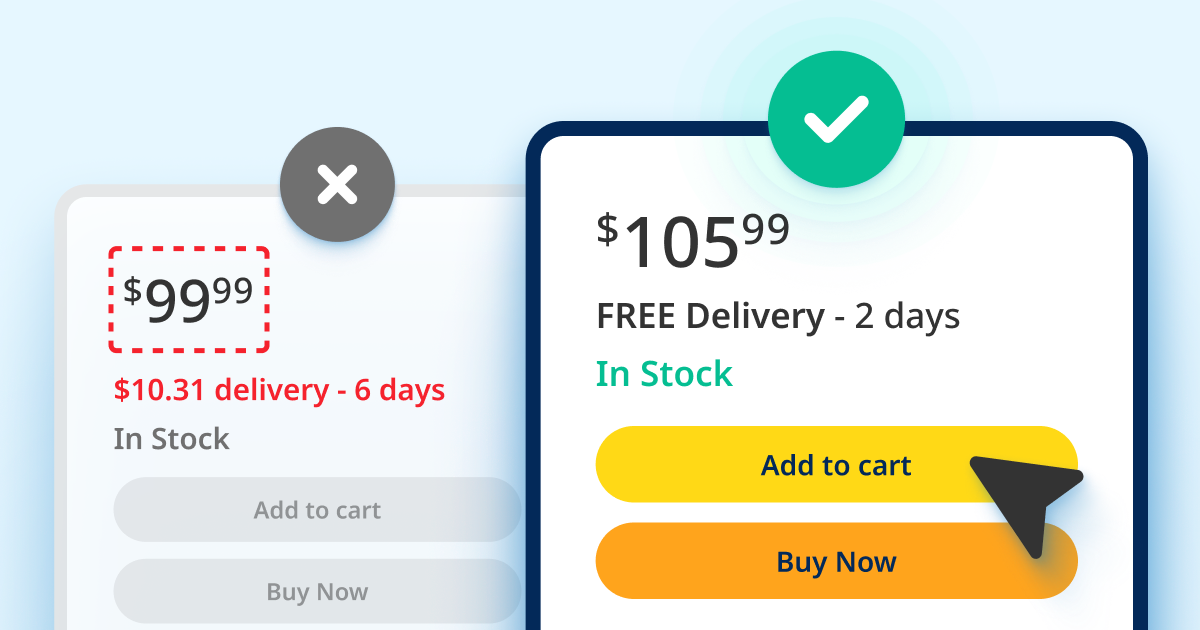
Winning the Buy Box doesn’t require being the cheapest seller. Marketplaces reward offers that deliver the best overall value. Sellers who balance price with fulfilment, performance, and availability often maintain Buy Box share while protecting margin.
What is the Buy Box for marketplace sellers?
The Buy Box is the primary offer shown to shoppers on marketplace product pages. For marketplace sellers, winning it means earning visibility by delivering the strongest combination of price, reliability, and customer experience, not simply the lowest price.
Why the “lowest price wins” belief is risky
For many marketplace sellers, the Buy Box feels like a simple equation: lowest price wins. That belief is widespread... and dangerous.
Price matters, but it’s only one signal in a much larger system designed to reward best overall value, not just the cheapest offer. Sellers who rely solely on undercutting competitors often win short-term visibility at the expense of long-term profitability.
Winning the Buy Box at higher prices isn’t a loophole. It’s the result of pricing strategically, understanding marketplace mechanics, and knowing when price should (and shouldn’t) do the heavy lifting.
How marketplaces evaluate Buy Box eligibility
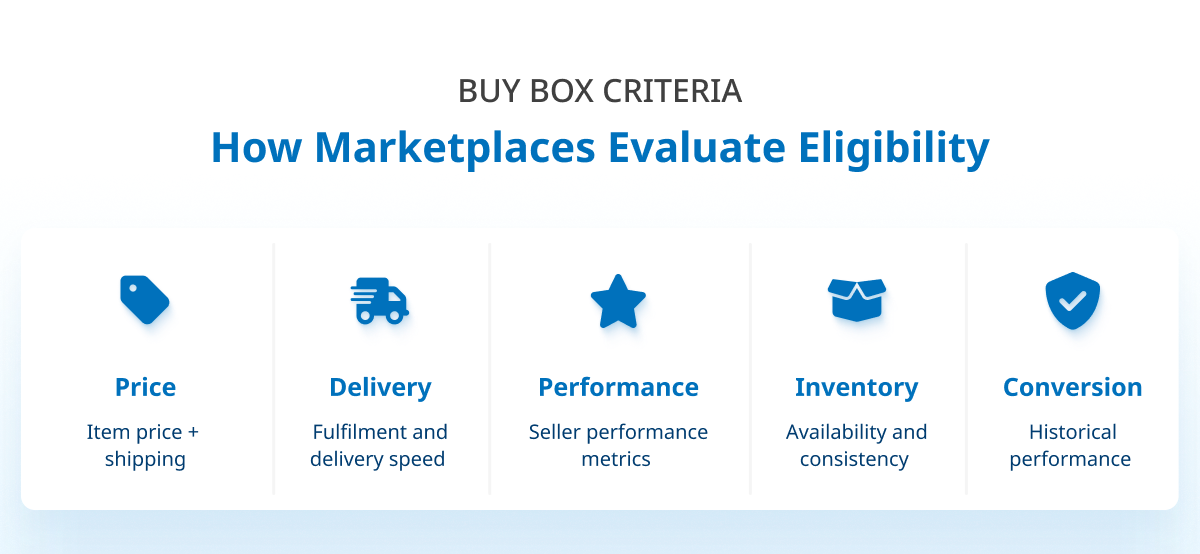
Marketplaces like Amazon evaluate offers using a combination of signals, including:
- Price (item price + shipping)
- Fulfilment method and delivery speed
- Seller performance metrics (ratings, cancellation rate, defect rate)
- Inventory availability and consistency
- Historical conversion performance
Price influences Buy Box eligibility, but it does not operate in isolation. Sellers with strong operational signals can often maintain Buy Box share even when they’re not the lowest-priced offer.
This is where many pricing strategies break down: they assume price is the only controllable variable, when in reality, it’s just one lever among several.
Why chasing the lowest price backfires
Aggressive price cutting creates three predictable problems:
- Margin erosion: lower prices increase volume only up to a point. Beyond that, additional sales often come at diminishing or negative returns.
- Competitive signaling: constant undercutting trains competitors to respond the same way, accelerating a race to the bottom that benefits no one.
- Loss of strategic flexibility: once margins are compressed, sellers have less room to absorb fees, promotions, or fulfilment cost increases.
Ironically, sellers who rely exclusively on price competition often lose Buy Box stability over time as their operational metrics suffer.
When higher prices still win
Sellers consistently win Buy Box share at higher prices when other value signals compensate for, or outweigh, price differences.
Common scenarios include:
- Faster or more reliable fulfilment: buyers often prefer speed and certainty over marginal savings.
- Stronger seller reputation: high ratings and low defect rates increase buyer confidence and conversion likelihood.
- Better inventory continuity: sellers who stay consistently in stock avoid algorithmic penalties tied to availability gaps.
- Optimized landed price: a slightly higher list price with free or faster shipping can outperform a cheaper offer with slower delivery.
Pricing is a strategy, not a reaction
The most effective Buy Box strategies don’t ask, “How do we beat the lowest price?” They ask, “What price maximizes share and profitability under current conditions?”
That requires moving beyond static pricing and into contextual pricing, where decisions adapt based on:
- Competitive density
- Demand velocity
- SKU importance
- Inventory position
- Performance signals
For example:
- High-velocity SKUs may justify tighter pricing to defend volume.
- Long-tail or differentiated products often support higher prices without losing Buy Box share.
- Temporary price adjustments can be used to regain visibility, then relaxed once performance stabilizes.
The key is intent. Price changes should serve a purpose, not react blindly to competitor moves.
Practical tactics for smarter Buy Box pricing
Once pricing decisions are informed by more than price alone, tactics become less about reacting and more about choosing when and how to intervene. In practice, smarter Buy Box pricing often looks like this:
- Adjusting pricing pressure based on competitive presence: when market intelligence shows a listing has few active, in-stock competitors, aggressive repricing is often unnecessary. Sellers can maintain Buy Box share with more conservative price moves until competitive pressure meaningfully increases.
- Using availability gaps to avoid unnecessary discounts: temporary stock-outs from competitors frequently create short-lived pricing opportunities. Recognizing these moments allows sellers to hold price (or adjust gradually) rather than immediately matching historic lows that no longer reflect current conditions.
- Tightening pricing only where competition is sustained: listings with consistently high seller counts and stable availability tend to require sharper pricing discipline. In these cases, pricing adjustments are deliberate and ongoing, rather than episodic reactions to one-off price drops.
- Differentiating pricing behavior across a product catalog: Market intelligence helps identify which SKUs function as traffic drivers and which operate with more pricing flexibility. High-visibility items may justify narrower margins, while less crowded or more differentiated products often support higher price positions.
- Revisiting price positions as conditions change: as assortment, availability, and seller behavior shift, so should pricing strategy. Reviewing Buy Box share alongside these signals over time helps sellers determine when price changes are still serving their intended purpose, and when they can be relaxed.
Taken together, these tactics help ensure pricing decisions reflect current market conditions rather than outdated assumptions or isolated price movements.
The Bigger Picture: Sustainable Buy Box Wins
Winning the Buy Box is about proving, to both the marketplace and the buyer, that your offer represents the best overall choice.
Sellers who price with discipline, protect margin, and optimize non-price signals often achieve more stable Buy Box share than those who rely on constant price cuts. The takeaway is simple but often overlooked: Buy Box performance improves when pricing reflects the full competitive context, not just the lowest offer.
*On the other hand, brands tend to think about the Buy Box less as a pricing lever and more as a way to maintain consistency across marketplaces. Read Buy Box Strategy for Brands to learn more.
FAQs
Q: Can sellers win the Buy Box without being the cheapest?
A: Yes. Strong fulfilment, performance metrics, and availability can outweigh small price differences.
Q: Does frequent repricing help Buy Box performance?
A: Not always. Excessive repricing can hurt margins and destabilize performance signals.
Q: Which matters more: price or fulfilment?
A: Both matter, but faster and more reliable fulfilment often improves conversion and Buy Box stability.
Q: Should every Buy Box loss trigger a price cut?
A: No. Losses should be evaluated in context: seller count, availability, and SKU role matter.