
Last Updated: September 14, 2026
Minimum advertised price (MAP) is the lowest price a retailer can publicly advertise a product for. While sellers may choose to sell below this price, MAP policies define what can be displayed across online listings, marketplaces, and promotions.
Most brands today already have some form of MAP policy in place. The challenge is not defining the policy. It is consistently monitoring compliance, identifying violations, and taking action in a way that protects brand value without creating operational strain.
If you are evaluating MAP monitoring software, the questions you ask will determine whether you end up with visibility alone or a MAP compliance monitoring program that actually works.
TL;DR
Choosing a MAP monitoring software solution is not just about detecting violations. The right platform should help your team act on violations, manage seller relationships, scale your workflow, and adapt as marketplaces evolve. Focus on enforcement workflows, usability, support, scalability, and cost drivers.
What to Look for in a MAP Platform
| Area | What to Look For | Why It Matters |
| Enforcement Workflows | Ability to group violations, send notices, and track actions | Turns MAP monitoring into consistent MAP policy enforcement |
| Usability | Clear dashboards and simple navigation | Drives adoption across ecommerce, pricing, and legal teams |
| Support | Onboarding, training, and ongoing guidance | Helps your MAP compliance monitoring program improve over time |
| Scalability | Handles more SKUs, sellers, and marketplaces | Supports growth without increasing manual work |
| Cost Structure | Transparent pricing tied to usage | Balances operational efficiency with budget |
Here are five questions to ask when choosing your next MAP monitoring software:
1. What happens after violations are identified?
Most MAP monitoring tools can surface violations. The real differentiator is what happens next.
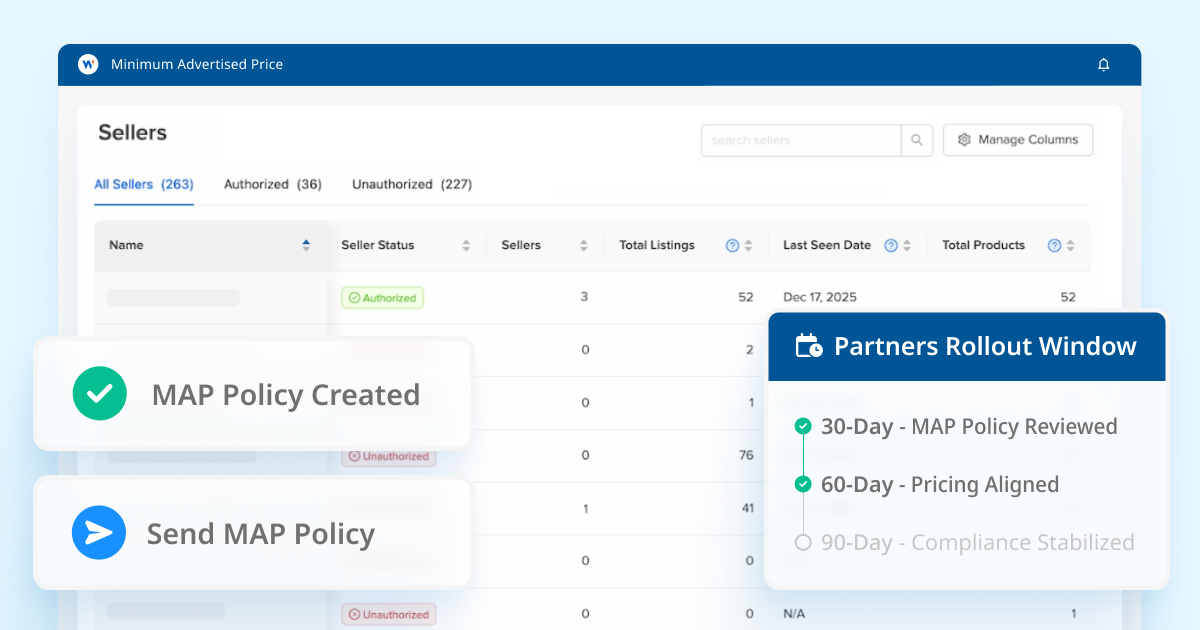
Look for a MAP enforcement software platform that supports structured workflows, including:
-
Grouping violations logically by seller, product, or timeframe
-
Sending consistent, trackable communications
-
Managing seller contact information in one place
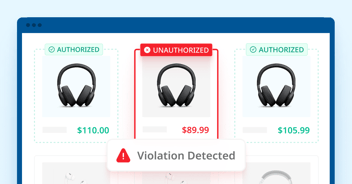
This becomes especially important when dealing with unauthorized sellers, where identifying violators and taking consistent action is critical to protecting your brand.
Without this, teams often end up exporting data into spreadsheets and managing MAP policy enforcement manually, which slows response time and creates inconsistencies. A strong platform should help you move from monitoring MAP violations to taking action without adding operational overhead.
2. How will this fit into your team’s day-to-day workflow?
MAP compliance monitoring is not a one-time task. It is an ongoing operational process that touches multiple teams, from ecommerce to legal to sales.
Consider:
-
How quickly can someone identify and act on a violation?
-
Is the interface intuitive enough for non-technical users?
-
Can leadership easily understand what is happening without digging through raw data?
Dashboards, reports, and exports all have a role, but the goal is clarity and speed. The best MAP pricing tools make it easier to monitor MAP violations and act on them. If the tool complicates your workflow, adoption will drop and your MAP compliance program will weaken over time.
3. What level of onboarding and ongoing support is provided?
Even the best MAP compliance tools will fall short without proper setup and ongoing guidance.
Look for a provider that offers:
-
Hands-on onboarding aligned to your MAP policy
-
Clear documentation, training resources, and walkthroughs
-
Ongoing support from real people who understand MAP compliance monitoring
MAP enforcement is rarely static. As your assortment, sellers, and channels evolve, your approach will need to adapt. A strong partner helps you refine your MAP compliance monitoring program over time, not just maintain it.
4. Can the platform scale with your business and the broader market?
Marketplaces are constantly changing. New sellers appear, pricing becomes more dynamic, and MAP enforcement becomes more complex.
Your MAP monitoring software should be able to grow with you by supporting:
-
Expanding product catalogs and seller networks
-
Flexible dashboards and reporting that evolve with your needs
-
Continued investment in automation and workflow improvements
No platform will have everything on day one, but a clear product direction and ongoing innovation are critical for long-term MAP compliance.
5. What are the true cost drivers?
Pricing for MAP monitoring software and MAP enforcement tools typically depends on several factors:
-
Number of sites or marketplaces monitored
-
Frequency of data collection
-
Number of SKUs tracked
Lower-cost MAP compliance tools may offer basic visibility but require more manual effort. More advanced MAP enforcement software often provides automation, better workflows, and stronger support.
The key is to understand the tradeoff between cost and operational efficiency. A platform that reduces manual work and improves MAP policy enforcement consistency can deliver significantly more value over time.
Closing Thoughts
A MAP policy is only as strong as your ability to enforce it. The right MAP monitoring software should not just show you where violations exist. It should help your team take consistent action, communicate effectively with sellers, and maintain control as your business grows.
As you evaluate MAP compliance monitoring solutions, focus on how each platform supports your real-world workflow. The goal is not just to monitor MAP violations. It is to build a program your team can rely on every day.
Wiser supports brands with MAP monitoring and enforcement by combining structured workflows, clear reporting, and scalable data collection across retailers and marketplaces. This allows teams to move from identifying violations to resolving them with confidence and consistency.
FAQs
What is MAP monitoring? MAP monitoring is the process of tracking advertised prices across retailers and marketplaces to identify MAP violations and ensure compliance with your MAP policy.
Brands use MAP monitoring software to automatically track pricing across ecommerce sites and marketplaces, helping teams quickly identify and respond to violations.
MAP monitoring identifies violations, while MAP enforcement involves taking action, such as contacting sellers, issuing warnings, or escalating repeated violations.
Look for strong enforcement workflows, ease of use, scalability, ongoing support, and the ability to fit into your existing MAP compliance monitoring process.
This depends on your category and pricing volatility. Many brands monitor MAP compliance daily, while others may choose weekly or less frequent tracking.