Last Updated: October 27, 2026
TL;DR
Unauthorized sellers create hidden pricing erosion by violating MAP, undercutting retailers, and weakening brand control. The most effective response is early detection, accurate seller visibility, and evidence-backed enforcement.
Amazon, Walmart, and other online marketplaces are a competitive hotbed of brands and resellers. It doesn’t take much to create a seller profile and start listing products online. The challenge for brands is managing those sellers and preventing any unauthorized sellers from causing problems.
At first glance, you might think that your product being sold on more sites means more sales for you.
That is, until you come across an unknown seller who isn't following your MAP policies. Or worse, is selling a product under your name, that isn't part of your network at all.
Identifying these unauthorized sales and stopping them is essential if you want to stay in control of your brand's image and authenticity.
Marketplaces have made selling frictionless, and that makes it easier for unauthorized sellers to appear. But not every unfamiliar seller is a threat. An unknown name could be an authorized reseller trading under a different business name, a distributor's marketplace account, or a genuinely unauthorized reseller.
What is Unauthorized Selling?
An unauthorized seller is any individual or business selling your products online without an approved relationship with your brand. These sellers often violate MAP policies, create pricing inconsistencies, and damage retailer trust over time. There are multiple ways an unauthorized seller may be doing this.
Broken MAP Policy
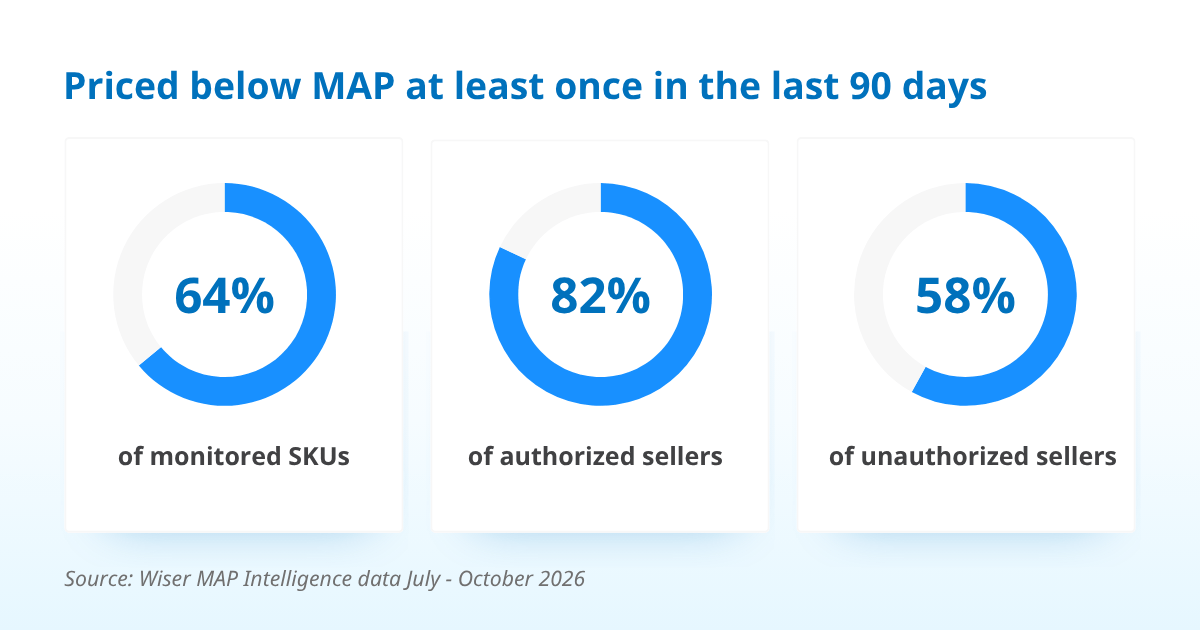
One common scenario is a seller listing your products well below your MAP. If you monitor marketplaces for MAP violators, this seller will appear in your list of sellers and stand out due to the MAP violation and the unknown company name. At this time, you have several options that highlight how difficult it can be to enforce MAP violations from unknown sellers.
Selling on Restricted Sites
Some brands do not sell their products on sites like Amazon or eBay in order to better control their brand image, reduce subscription costs, or to make it easier to identify unauthorized sellers. If your brand doesn’t use specific sites and your products are still being sold there, then there is clearly a violation taking place.
Counterfeit Products
This type of reselling can be particularly harmful to your brand because the products being sold aren't actually yours but will still reflect badly on your brand's name. Unauthorized sellers will obtain or create knockoff versions of your merchandise and use the good reputation of your name to sell them.
These items are often low-quality and result in negative responses from customers.
Unknown vs. unauthorized sellers
An unknown seller is one you haven't verified yet. An unauthorized seller is one you've confirmed has no approved relationship with you. Treating the first as the second wastes enforcement effort and can damage relationships with legitimate partners.
Why It’s Hard to Identify Unauthorized Sellers
Spotting an unfamiliar seller is easy. Knowing who is really behind it, and whether it's authorized, is the hard part.
Multiple storefront names-One operator can run several storefronts, on one marketplace or across many. Each looks like a small, separate business.
Seller aliases-After a notice or suspension, a storefront often changes its display name rather than its behavior. "BestDeals Outlet" and "BDO Direct" look like two sellers but may be one operator with one violation history.
You can:
- Manually track down the seller, perhaps buying from them to get an address. However, many unauthorized sellers use P.O. Boxes.
- Research the seller online, but there’s a good chance they don’t publicize accurate addresses and contact information.
- Enlist a third-party provider to help with online enforcement and policing.
- Do nothing and let unauthorized sellers continue to operate.
The bottom line is that some unauthorized sellers hide their identities, use false or inaccurate information to register, or continually change their names to remain in business.
Where Does Unauthorized Selling Usually Take Place?
As previously mentioned, online retail sites that allow any user to make a profile and sell are good places to monitor, such as Amazon or eBay. But there are other places that could be hotspots for unauthorized selling.
Retailer Websites
Unauthorized sellers aren't always boogey-men operating behind secrecy, they could simply be reputable companies that don’t work with you yet. Your brand likely has a variety of authorized sellers across a wide array of retail sites, and it's inevitable that they’re not representing your brand properly—either in terms of pricing or merchandising.
If your potential customers find your items cheaper online, for example, they are more likely to purchase from that site, and cost you profits.
Gray Market Websites
The gray market, much like the black market, is not an actual physical place. If items are being sold on the gray market, that means the unauthorized reseller has obtained your merchandise through unauthorized means, like stolen goods.
These sellers may look legitimate to customers, but because they are unknown to you, they are not being held accountable to your policies.
Signals to watch-No single signal is proof. Patterns across signals point you to the right sellers.
|
Signal |
What it may indicate |
What to check next |
|---|---|---|
|
New storefront creation |
Diverted stock or a renamed violator |
Seller history; matching inventory elsewhere |
|
Sudden price drops |
Discounted or diverted inventory |
Rule out promotion, bundle or variation |
|
Changes in product descriptions |
Gray-market or non-standard stock |
Images, warranty language, bundle contents |
|
Matching inventory across identities |
One operator behind several storefronts |
Price moves, timing, cross-marketplace presence |
What You Can Do to Stop Unauthorized Sellers
Verify before you enforce
1. Confirm the violation is real. A price below MAP can come from an approved promotion, a bundle, a different product variation or a data-matching error.
2. Check the seller against your authorized reseller and distributor list. Keep the list current with every storefront name and marketplace ID each partner uses.
3. Document the seller, product, advertised price, marketplace, time and violation history. If you can't document it, you're not ready to enforce.
As noted above, you have many options to address unauthorized sellers. However, few will work if you cannot get in contact with the seller in question.
One option is to go through the marketplace. Amazon has a few services that can benefit brands in these instances. One is the Amazon Brand Registry, which allows you to register your brand as the owner of your products and services. When confronted with an unauthorized seller, you can report them to Amazon and, as a registered brand, can clearly prove that the other party is not authorized to sell on the marketplace.
You can send a cease-and-desist letter to the unauthorized seller’s address and hope that it is accurate. Perhaps the seller is legitimate and is simply violating MAP. There’s always a chance that the company is not concealing its identity online.
Or, you can use a system designed to help you identify unauthorized sellers early and act before the situation escalates. When you have consistent visibility into who is selling your products and how they are pricing them, enforcement becomes far more manageable.
Skullcandy saw this firsthand: unauthorized sellers were pricing its products as much as 50% below MAP. Across its monitored SKUs, that put up to an estimated $35 million in annual revenue at risk. Read the Skullcandy story
Wiser’s MAP Intelligence helps brands monitor pricing activity, surface unfamiliar sellers, and capture the evidence needed to support follow-up and enforcement across online marketplaces. With clearer visibility and reliable data, teams can protect brand value, address gray market activity sooner, and take action with confidence. You can only enforce when you know who to contact, and MAP Intelligence helps turn that visibility into meaningful action. Wiser MAP Intelligence also lets you merge a seller's storefront names into one record, so violations count toward a single enforcement history.
Go deeper: Beyond MAP Monitoring: The Guide to Smarter Pricing Control in 2026 covers new tactics for tackling unauthorized sellers and cross-border arbitrage. Download the free guide