
TL;DR
MAP enforcement issues rarely stem from weak policies. Most failures happen when violation notices don’t reach the right people, supply partners aren’t aligned, or MAP is applied too broadly across products that don’t require price stability. Brands that strengthen MAP enforcement by improving communication, coordination, and product scope see fewer repeat violations and more consistent compliance.
Key Takeaways
-
MAP enforcement breaks down due to execution gaps, not unclear policy language
-
MAP Violations persist when notices fail to reach sellers who control pricing decisions
-
Supply-side misalignment enables repeat non-compliance across channels
-
Applying MAP to every product creates noise and strains partner relationships
-
Focused enforcement on the right sellers and products leads to more durable compliance
Strengthening MAP Enforcement with Stronger Execution
Once a MAP policy is live, its effectiveness depends far less on the policy itself and far more on the operational reality of how enforcement happens day to day. Most enforcement challenges do not come from unclear rules or policy language, but from breakdowns in execution, communication, and coordination. The gaps below represent the most common organizational issues that lead to persistent violations and the areas brands can strengthen to create a more durable, repeatable approach to MAP enforcement.
1. Make Sure MAP Violation Notices Reach the Right Decision-Makers
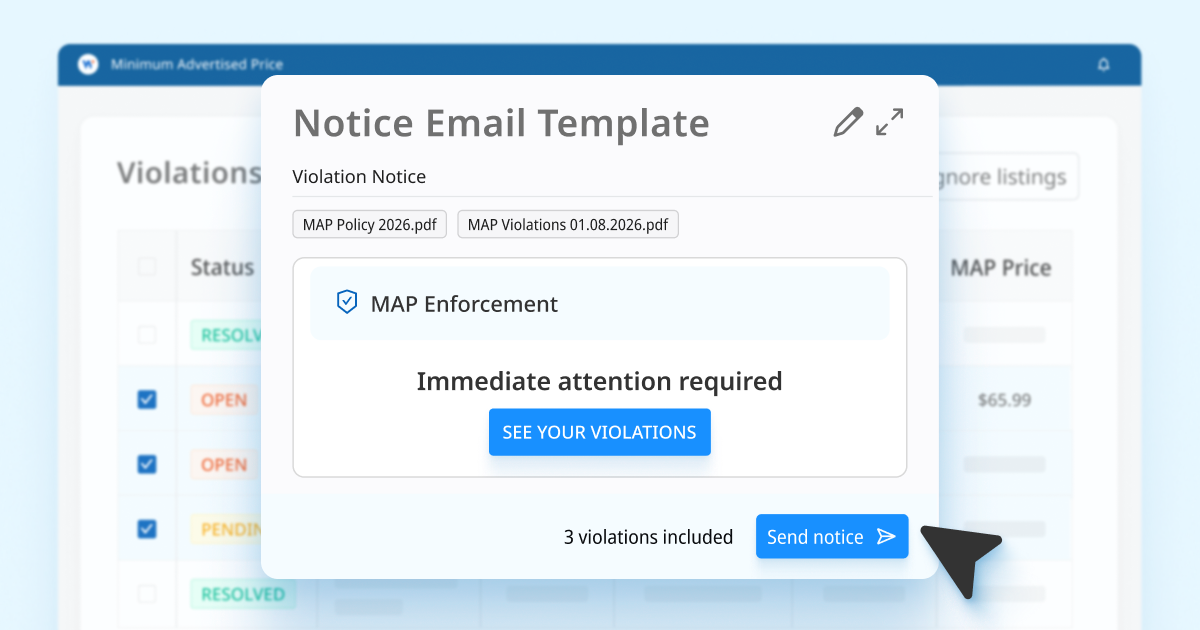
One of the most common reasons MAP violations persist is not seller resistance, but when notices don't reach the people who control pricing decisions. If violation notices are not landing with the people who can actually change pricing, enforcement effectively stops before it starts. Brands may believe they are enforcing MAP, but without confirmed delivery to the right decision-makers, compliance cannot follow.
Seller contacts change. Marketplaces rotate staff. Email addresses go stale. When MAP communication relies on outdated or unverified contact information, violations linger simply because no one with authority has seen the notice. This creates a false sense of enforcement coverage while non-compliant listings remain active.
Confirming and maintaining accurate reseller contacts is one of the fastest ways to regain control of enforcement. Visibility into bounced messages or unacknowledged outreach removes guesswork and makes it clear which sellers are reachable, and which are not.
When violation notices reach the right people, sellers understand what needs to change and why, and compliance improves because enforcement is real, not assumed.
2. Bring Distributors and First-Party Sellers into the MAP Enforcement Process
Many recurring MAP violations come from sellers who were never meant to receive the product in the first place. Inventory leaks, secondary markets, or informal sourcing channels can place product outside the brand’s direct control and into the hands of parties who:
- Were never authorized to sell the product
- May not have a direct relationship with the brand
- May not feel bound by MAP at all
When brands focus only on listing-level enforcement and ignore how inventory is supplied and resold, violations become repetitive and difficult to resolve.
Understanding how resellers source and receive product helps brands distinguish between operational friction and deliberate non-compliance and respond appropriately. This is where distributor and first-party alignment matters. Brands should actively:
- Share “do not sell” lists with distributors and first-party sellers
- Flag repeat offenders so supply can be addressed, not just listings
- Reinforce expectations around authorized resale and pricing discipline
When distributors and first-party sellers understand their role in MAP protection, enforcement becomes systemic rather than manual. Violations decline not because sellers are chased more aggressively, but because the supply that enables non-compliance is reduced at the source.
3. Refine Your MAP Product List to Reflect Real Market Conditions
One of the fastest ways to improve MAP outcomes is not to enforce MAP more broadly, but to enforce it more intelligently. Applying MAP to every product can inflate violation counts, strain partner relationships, and distract teams from the items that actually require price stability.
MAP does not need to apply to every product. Resellers often discount slow-moving or aging inventory to manage warehouse space and cash flow. When MAP restricts this flexibility, it creates unnecessary friction and generates violations that do little to protect brand value.
A strong MAP program revisits its protected list regularly and removes products that:
- Are aging or stagnant
- Need flexibility to move through the channel
- No longer require price stability
Protect the products that need it most. Give the others room to move so they don’t generate noise that distracts from real enforcement priorities. This kind of calibration keeps MAP relevant, realistic, and aligned with actual business conditions.
Wiser’s Role in Supporting Consistent MAP Enforcement
Even the most well-designed MAP program depends on reliable enforcement for success. Wiser’s MAP Intelligence helps brands manage this work by centralizing violation tracking, proof, communication, and reporting so teams can respond faster and with greater consistency. A single system for monitoring patterns, reviewing evidence, and sending outreach keeps enforcement organized and reduces the friction that often slows MAP programs down.
Using MAP Intelligence to Strengthen MAP Enforcement
Most MAP challenges come down to communication, coordination, and follow-through. When violation notices reach the right people and supply partners are aligned, brands can focus MAP protection where it matters most and create a more compliant pricing environment.
Effective MAP enforcement is not about being more aggressive or enforcing more rules. It is about maintaining control across the channel and applying discipline where it delivers real value.
With a platform like Wiser’s MAP Intelligence, teams can close these enforcement gaps and prevent the same violations from resurfacing again and again.
If you’d like to see how Wiser’s MAP Intelligence can support your enforcement workflow, visit our product page or connect with your Wiser representative.
FAQs
Q: Why do MAP violations continue even after notices are sent?
A: Violations often persist because notices don’t reach the people who control pricing. Outdated contacts or indirect seller relationships can prevent enforcement messages from driving real compliance.
Q: Should MAP apply to every product in a brand’s catalog?
A: No. Applying MAP too broadly creates unnecessary friction and inflates violation volume. Regularly refining the MAP product list helps brands focus enforcement where price stability matters most.
Q: How do distributors and first-party sellers affect MAP enforcement?
A: When distributors and first-party sellers aren’t aligned on MAP expectations, inventory can continue flowing to non-compliant sellers. Supply-side coordination helps reduce violations before they appear in the market.